02 February 2026
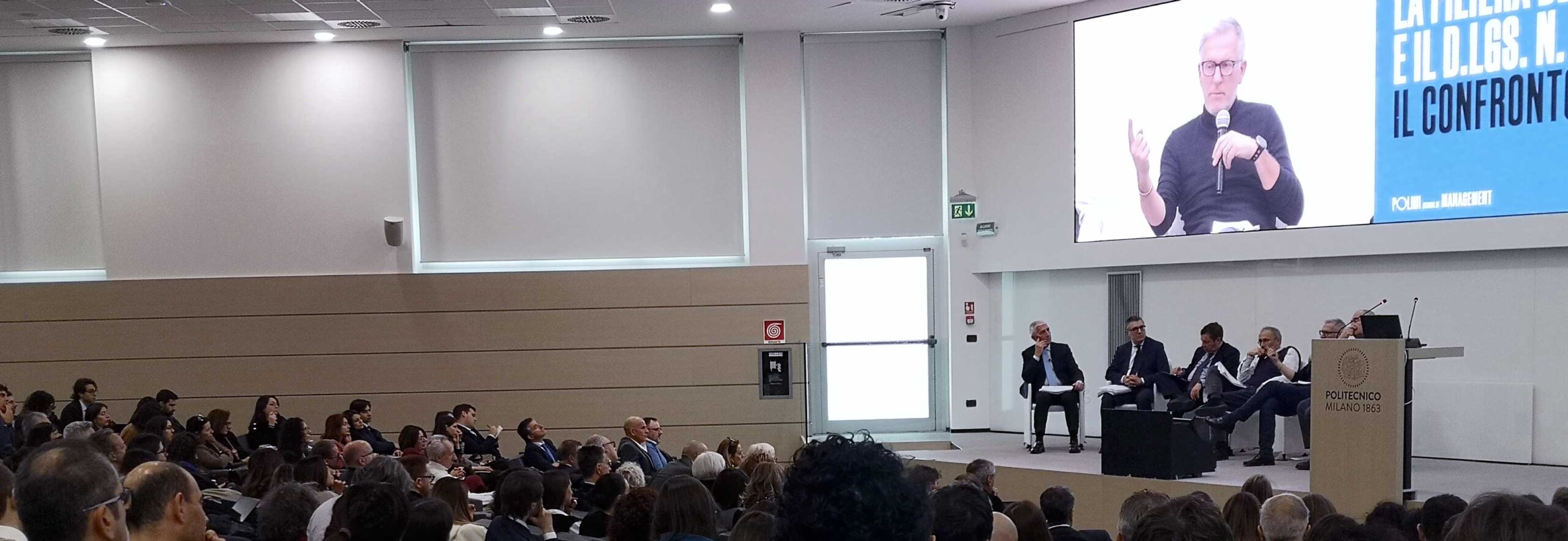
Today, the fashion supply chain is the focus of growing public and institutional attention, particularly following the investigations launched in recent years by the Milan Court into subcontracting practices and labour exploitation. It was against this backdrop that the conference “The Fashion Supply Chain and Legislative Decree 231/2001 – A Dialogue” took place, promoted by the POLIMI School of Management and the National Observatory on Legislative Decree 231/2001 of the National Council of Chartered Accountants and Accounting Experts (CNDCEC). The aim was to take stock of the tools available to strengthen transparency and legality along the value chain.
The event brought together leading figures from the judiciary, academia, the professions and the business world, offering a multidisciplinary perspective on the main challenges and potential solutions. Participants included: Paolo Storari, Deputy Public Prosecutor at the Milan Court; Luca Sburlati, President of Confindustria Moda – Textile and Apparel Federation; Ciro Santoriello, Deputy Prosecutor at the Cuneo Court; Gianluca Varraso, Professor of Criminal Law at Università Cattolica; and Andrea Sianesi, Professor at the POLIMI School of Management and member of the working group that drafted the Protocol for Legality in Fashion Supply Chain Contracts.
The conference opened with institutional greetings from Raffaella Cagliano, Director of the Department of Management, Economics and Industrial Engineering at Politecnico di Milano, and the discussion was then coordinated by Salvatore Sodano, President of the National Observatory on Legislative Decree 231/2001 of the CNDCEC.
At the heart of the debate was Legislative Decree 231/2001 and the role of organisational, management and control models as tools for preventing criminal, reputational and compliance risks, particularly in subcontracting and supply relationships. The need to ensure that such models are genuinely effective and fully integrated into corporate processes emerged clearly, moving beyond a merely formal approach.
A significant part of the discussion focused on the Protocol for Legality (Protocollo di intesa per la legalità), signed in May at the Milan Court by all key stakeholders in the sector. As part of the Protocol, work is underway on a platform for collecting data on production supply chains, a prerequisite for issuing the fashion sector’s transparency certification. The platform, due to go live in the coming months, is being developed by the Lombardy Region with the support of the Department of Management, Economics and Industrial Engineering at Politecnico di Milano, on behalf of the Prefecture and the Milan Court.
The meeting reaffirmed the importance of a shared approach to responsibility across the supply chain, highlighting how transparency requires coordinated engagement from businesses, institutions and supervisory bodies. In this context, dialogue between the judicial system, industry and the research community emerged as a key factor in strengthening fairer, more sustainable and more competitive supply chain practices.
Condividi